
Best churches in Vilnius
Compare Vilnius's most beautiful churches by architecture, access, route fit, photos and quiet visiting etiquette.
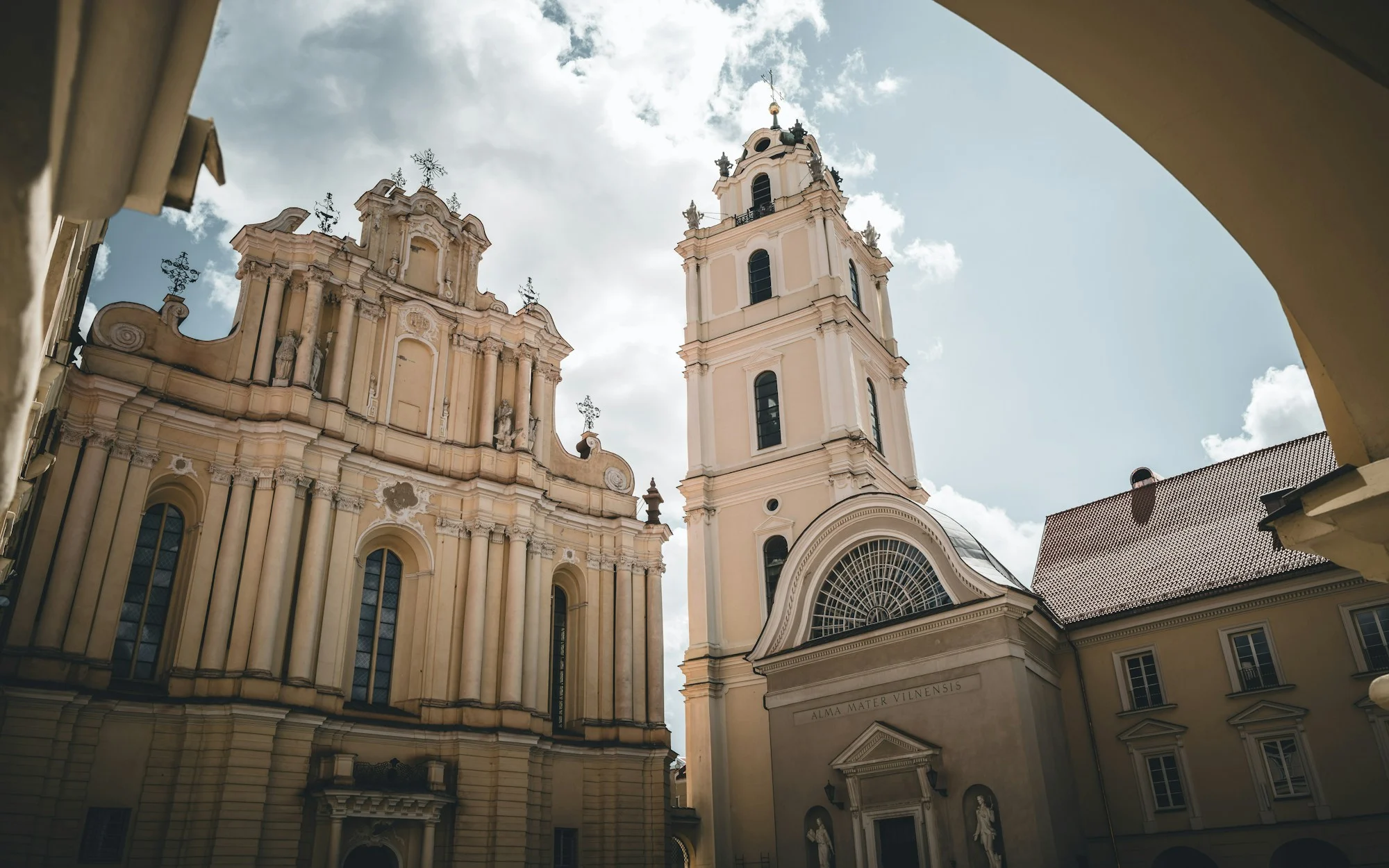
- ✓Vilnius is one of Europe's great Baroque cities, and its skyline of spires is the easiest way to read its layered history — Gothic, Renaissance, Baroque, Orthodox and modern all within a short walk.
- ✓Most churches are free to enter; the etiquette is simple — quiet, shoulders and knees covered, no flash during services — and the rewards are enormous.
- ✓You can string the headline churches into a single Old Town loop: Cathedral, St Anne's and the Bernardine complex, Sts Peter and Paul, St Casimir's and the Gates of Dawn chapel.
- ✓Hours shift with the liturgical calendar and restoration work — we flag the volatile ones to verify before you go.
- ✓Written by people who live here: which churches reward a detour, which to skip if you're short on time, and how to visit respectfully.
Why Vilnius is a city of churches
Few capitals wear their faith as visibly as Vilnius. The Old Town skyline is a thicket of towers and domes, and the churches beneath them tell the whole story of the city in stone: Gothic brick from the late Middle Ages, the Italianate flourish of the Renaissance, the soaring drama of the Baroque, the onion domes of Orthodoxy, and the clean lines of the twentieth-century rebuilds. Walking from one to the next is the single best way to understand how Vilnius grew, who ruled it, and what survived.
What makes the churches so rewarding is how close together they sit. The UNESCO-listed Historic Centre is compact enough to cross on foot in an afternoon, and the great religious buildings cluster along a handful of streets — around Cathedral Square, along Pilies and Maironio, and up the slope to the Gates of Dawn. You can see the headline acts in a focused morning, or slow down and spend a full day ducking into side chapels, lighting a candle, and listening to an organ rehearsal echo off a Baroque ceiling.
This guide is not an exhaustive directory of every parish in the city — Vilnius has dozens of churches, and the live See & Do listings cover the long tail. Instead it ranks and groups the ones worth your limited time, explains what sets each apart, and gives you a route that links them without backtracking. Treat it as a shortlist from locals rather than a checklist.
It helps to understand why there are so many. Vilnius was for centuries the great multi-faith capital of the Grand Duchy of Lithuania and later a key city of the Polish-Lithuanian Commonwealth, a meeting point of Catholic, Uniate, Orthodox, Jewish, Protestant and Old Believer communities. Rulers, religious orders and noble families competed to endow ever grander churches, and the Counter-Reformation poured Baroque money into the city. War, fire and Soviet repression took their toll — many churches were closed, looted or turned into warehouses under the USSR — yet an extraordinary number survived, and most have been lovingly restored since independence in 1990. The result is a living museum of European church architecture compressed into a few square kilometres.
Vilnius Cathedral and Cathedral Square
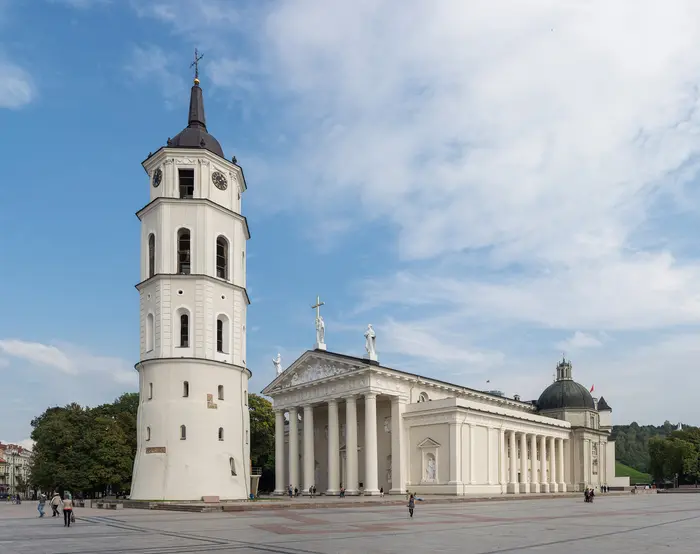
Start where the city starts. Vilnius Cathedral — formally the Cathedral Basilica of St Stanislaus and St Ladislaus — stands on the spot where, legend has it, a pagan temple to the thunder god Perkūnas once burned. The current building's severe neoclassical facade, with its row of columns and crowning statues, looks more like a Greek temple than a Gothic minster, the result of a sweeping late-eighteenth-century redesign by Laurynas Gucevičius. Step inside and the mood changes: the Chapel of St Casimir, patron saint of Lithuania, is a riot of Baroque marble, silver and frescoed saints.
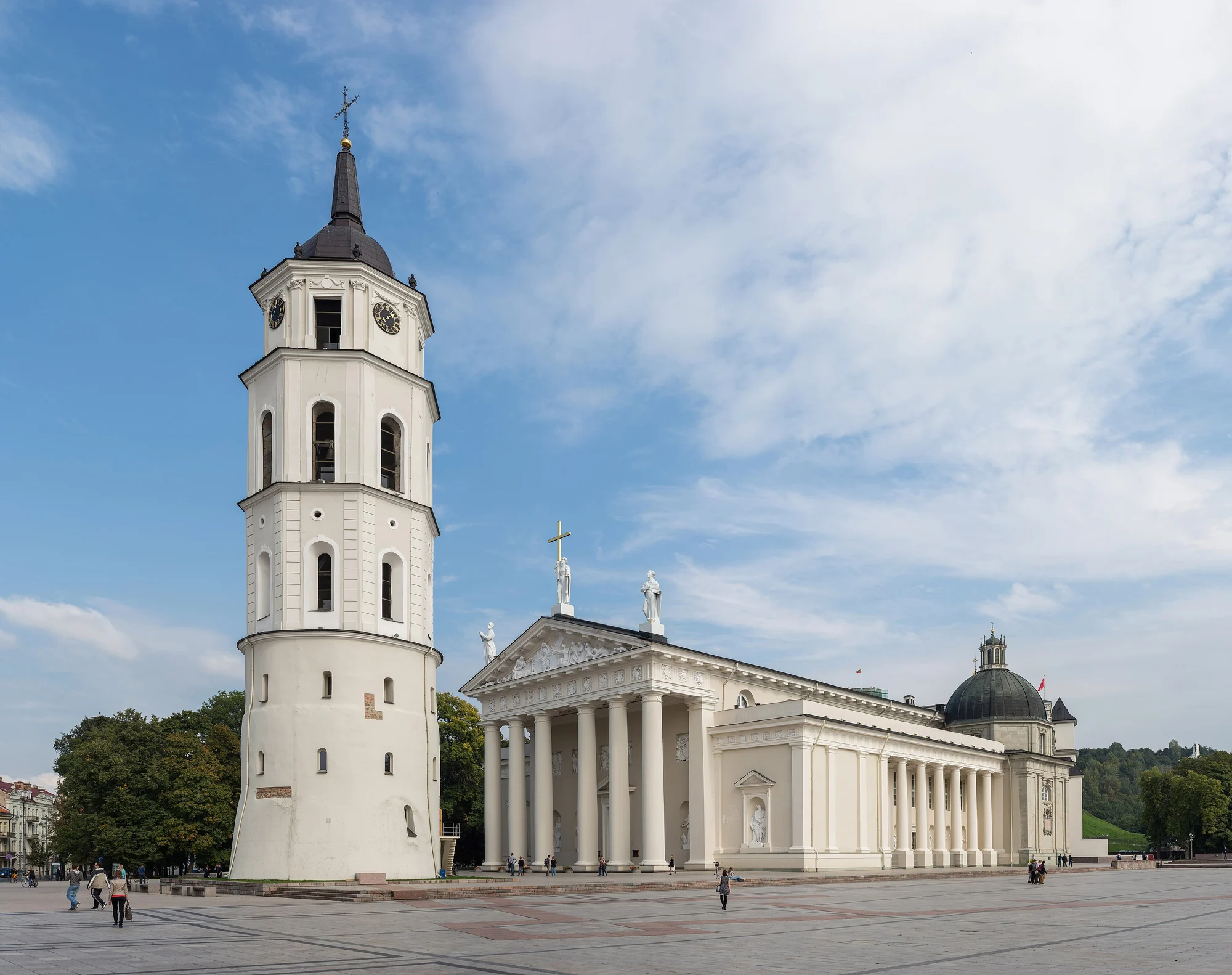
The freestanding bell tower on the square is one of the most photographed objects in Lithuania, and the square itself is the city's living room — protest rallies, Christmas markets, midsummer concerts and the daily flow of locals cutting across it. Look down for the famous stebuklas ('miracle') tile, where people spin three times and make a wish. The Cathedral's crypts and treasury can be visited on guided tours; the main nave is free.
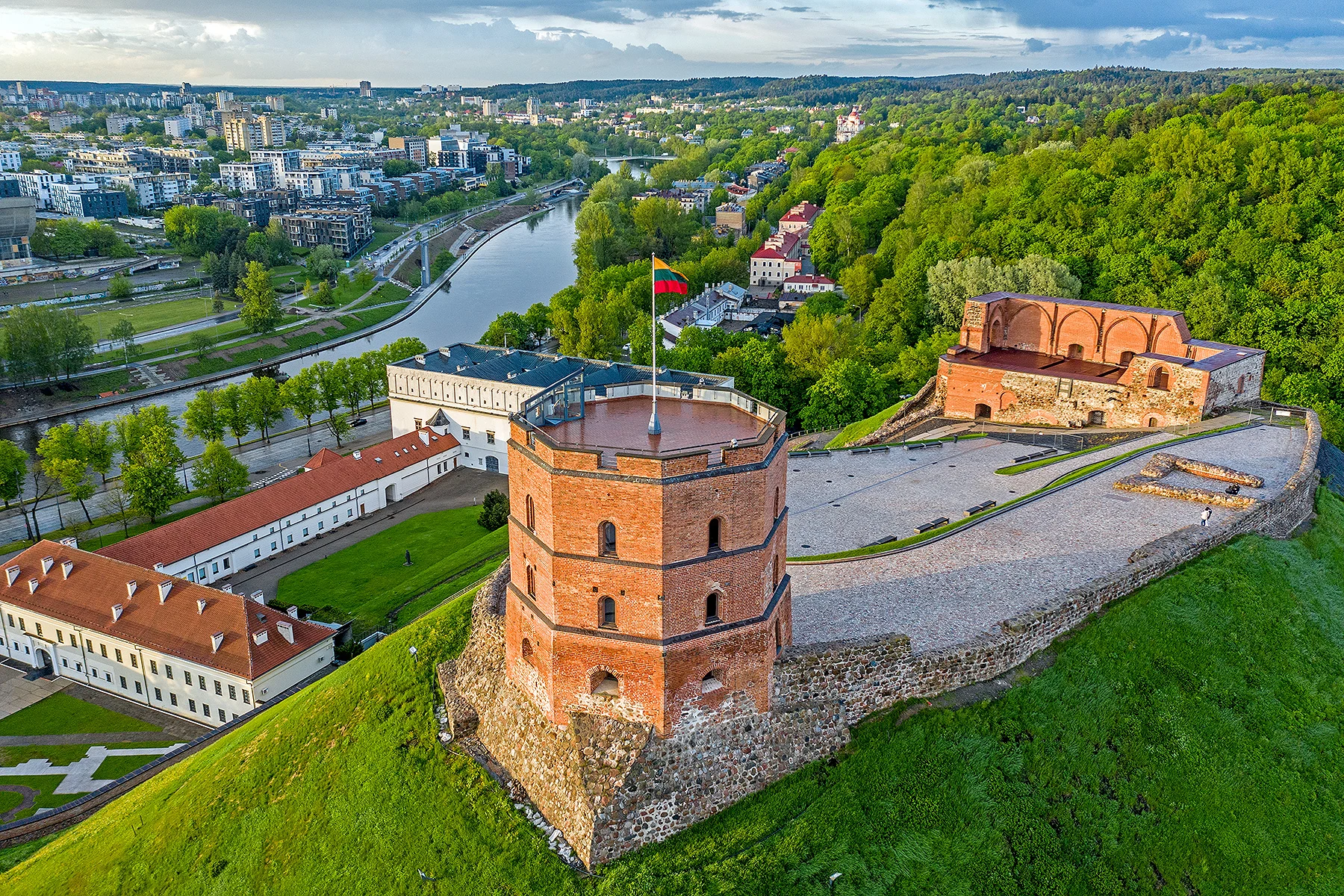
From the square it's a two-minute walk to the funicular up Gediminas Hill, so it makes sense to pair a Cathedral visit with the castle and a first long look over the rooftops.
A note on what to look for inside: beyond St Casimir's Chapel, seek out the crypts beneath the Cathedral, where members of the Lithuanian and Polish nobility — including Grand Dukes and the heart of King Władysław IV — are interred, and where some of the oldest frescoes in Lithuania survive. These lower levels are reached only by guided tour, booked through the Cathedral, and they reward the effort with a vivid sense of how many times the building has been flooded, rebuilt and reconsecrated on the same sacred ground. Above, the main nave is bright, restrained and free to enter throughout the day outside of services.
Full guide to the cathedral, bell tower and St Casimir's Chapel.
Cathedral SquareThe city's central square and its miracle tile.
Gediminas CastleThe hilltop tower a short walk from the Cathedral.
Map pins
Map data © OpenStreetMap contributors · Tiles © OpenFreeMap
St Anne's and the Bernardine complex — the Gothic showpiece
If Vilnius has one church that stops visitors mid-step, it is St Anne's. This is late-Gothic brickwork at its most theatrical: a facade assembled from dozens of moulded brick shapes into a flickering, flame-like composition that seems to be in motion. Napoleon, the story goes, wished he could carry it back to Paris in the palm of his hand — apocryphal, almost certainly, but it captures the effect. The church is small inside; the magic is all on the outside, so give yourself time to circle it and watch the brick change colour as the light moves.
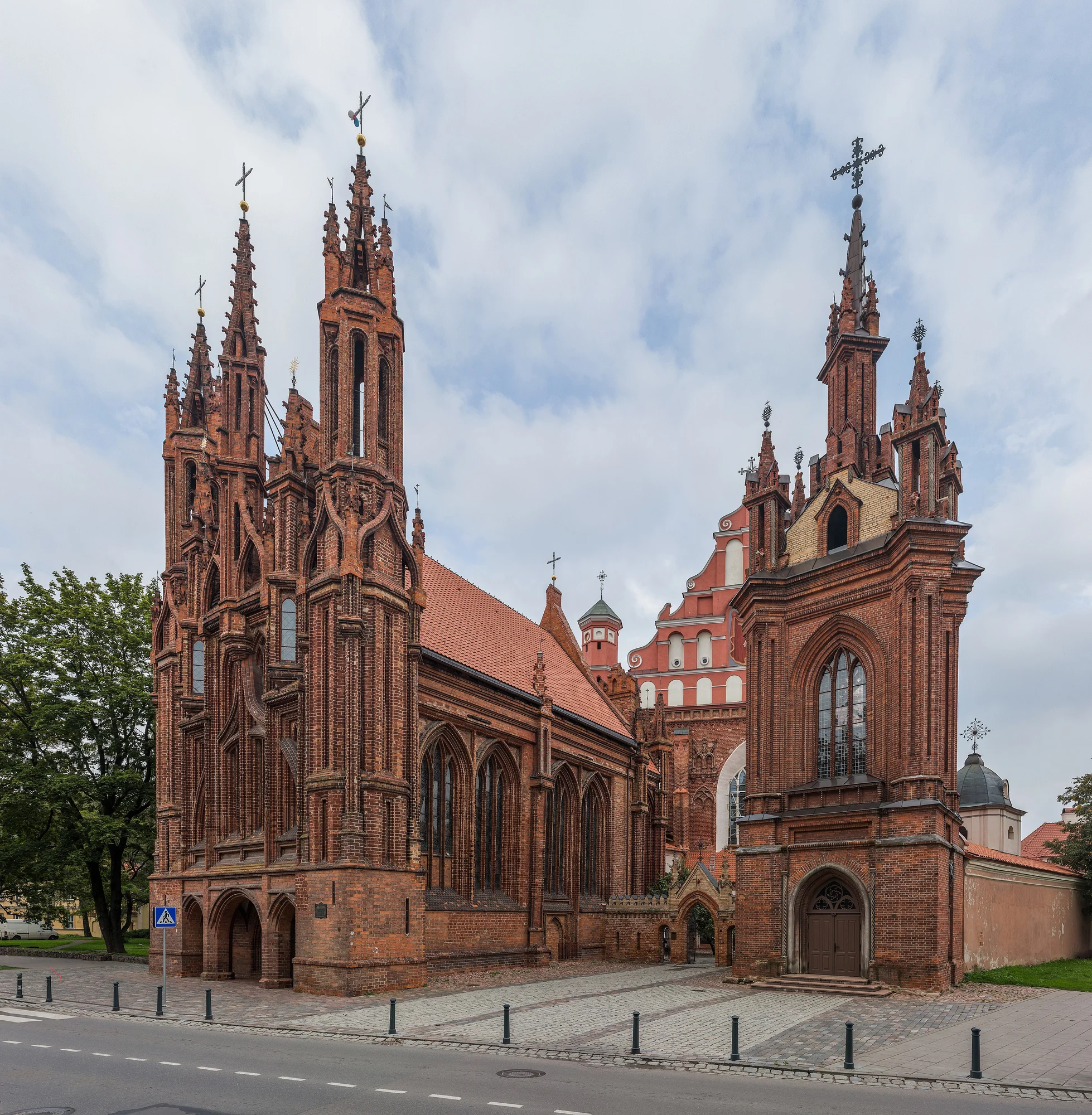
Right behind it rises the much larger Church of St Francis of Assisi and St Bernardine (the Bernardine Church), part of a former monastery complex, with the leafy Bernardine Garden stretching beyond toward the river. Together the two churches form one of the most photographed ensembles in the city, and the garden makes a natural place to pause, especially in spring blossom or autumn colour. From here it's a short bridge across the Vilnia to Užupis.
Hours at St Anne's are limited and tied to services, so check before making a special trip; the Bernardine complex keeps longer parish hours.
- St Anne's Church — late-Gothic brick facade; best photographed late afternoon.
- Bernardine Church (St Francis & St Bernardine) — large former monastery church directly behind.
- Bernardine Garden — a calm green pause between the churches and the river.
- Five minutes on foot to Užupis across the Vilnia.
Sts Peter and Paul — Baroque overload in white
Out in the Antakalnis district, a short ride or a pleasant riverside walk from the centre, the Church of Sts Peter and Paul hides one of the most astonishing interiors in Northern Europe behind a relatively plain exterior. Step through the door and the entire ceiling and walls dissolve into white stucco — an estimated two thousand sculpted figures of saints, soldiers, demons, animals, plants and biblical scenes, all in dazzling chalk-white relief, created by Italian masters in the seventeenth century. There is no gold and almost no colour; the effect is overwhelming precisely because it is monochrome.
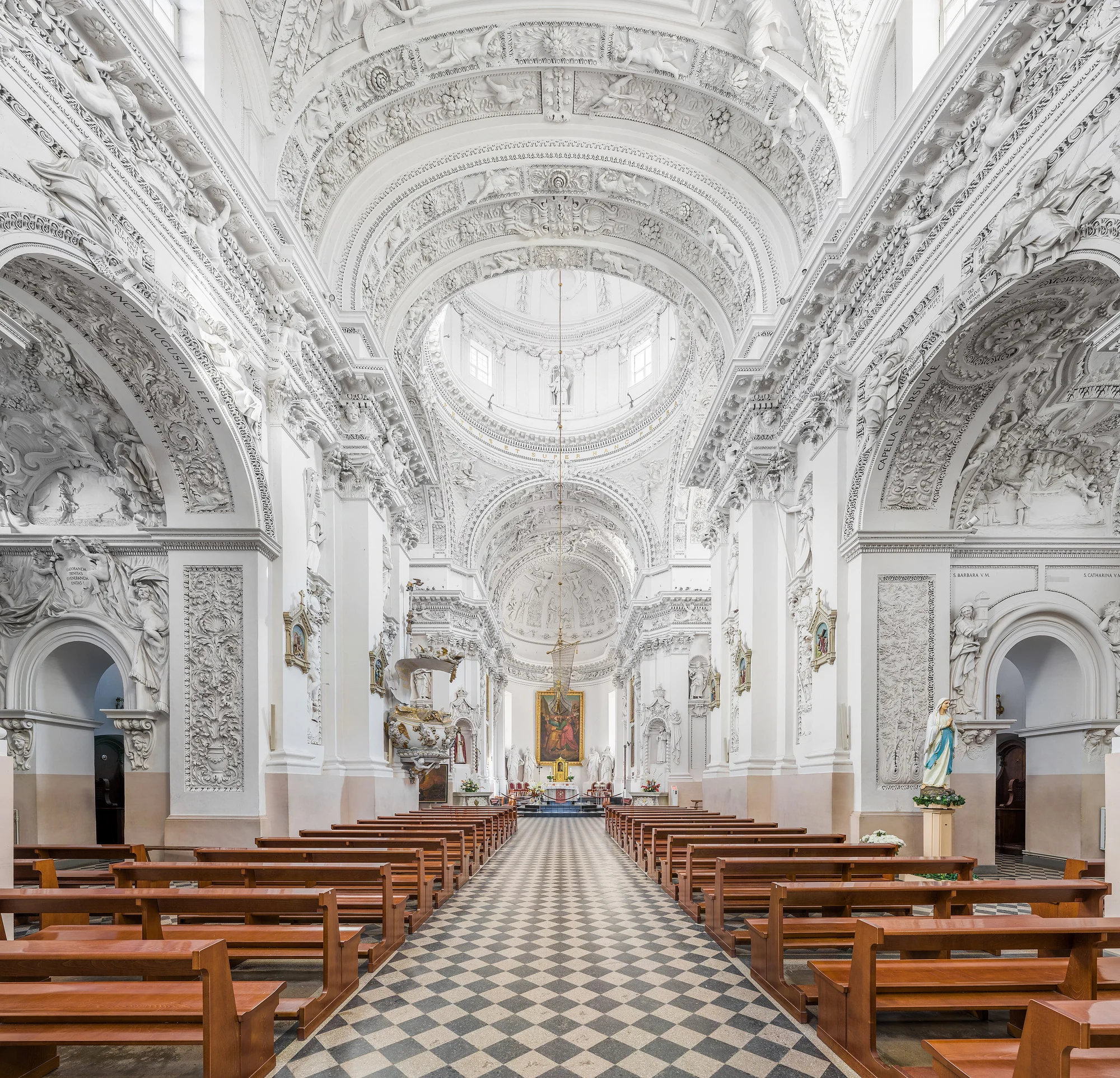
Look for the boat-shaped chandelier of glass beads hanging in the nave, the Queen of the Sea, and the dense thicket of figures over your head that rewards a slow, neck-craning circuit. It is free to enter and usually open through the day, which makes it one of the easiest 'wow' stops in the city for travellers who think they have seen enough Baroque.
Because it sits slightly out of the Old Town, pair it with a walk along the Neris or a visit to the Antakalnis area rather than trying to cram it into a tight central loop.
The Gates of Dawn and Aušros Vartų Street
At the southern edge of the Old Town stands the Gates of Dawn, the last surviving gate of the medieval city wall — and above its arch, a small chapel that draws pilgrims from across the Catholic world. Inside hangs the image of Our Lady of the Gates of Dawn, the Mother of Mercy, framed in beaten silver and gold; it is one of the most venerated Marian icons in the region, equally cherished by Lithuanian, Polish and Belarusian believers. You reach the chapel up a staircase from the street, and even non-religious visitors find the candlelit, hushed space moving.
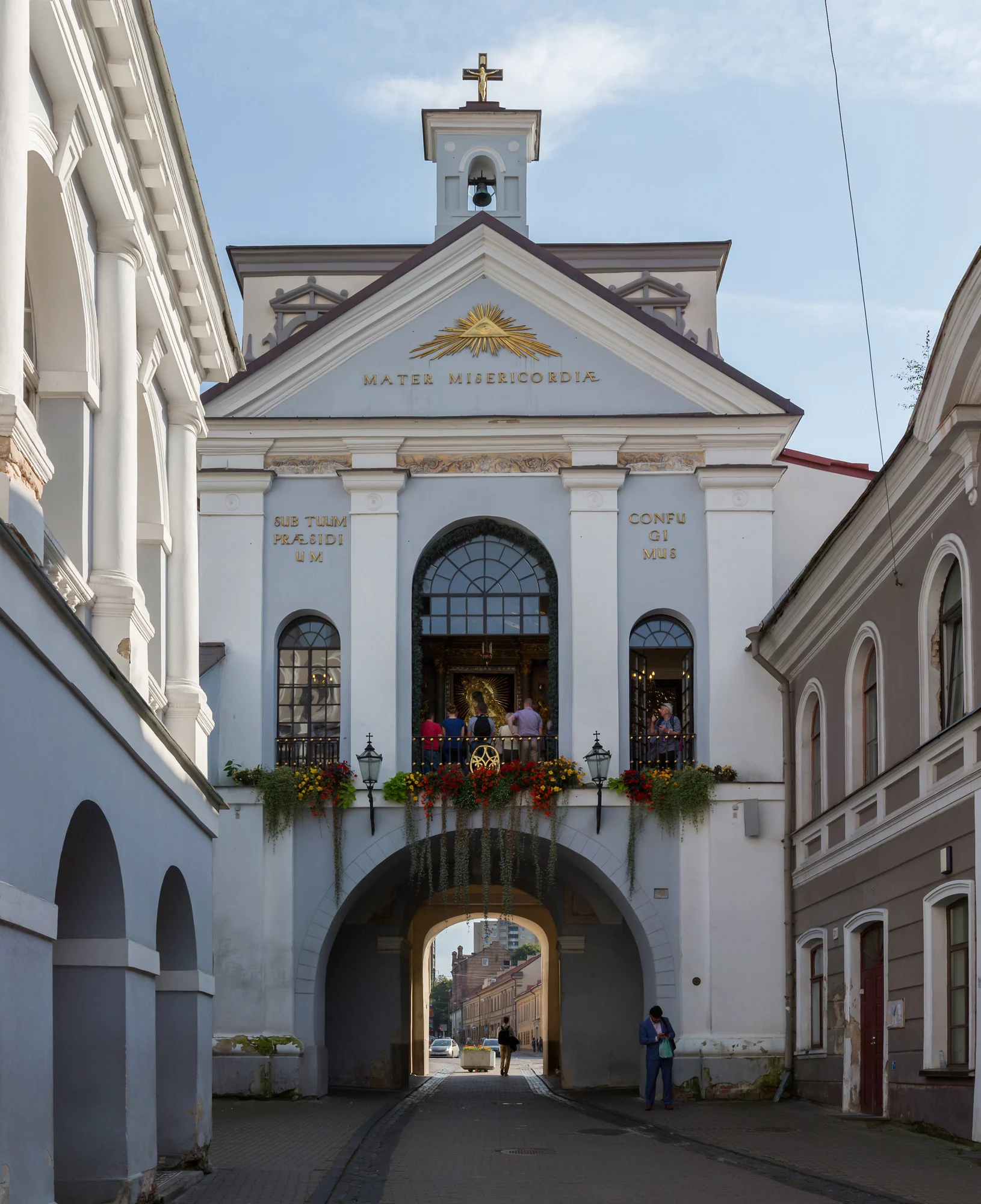
The walk up to the gate, along Aušros Vartų Street, is itself a string of churches and courtyards — the Orthodox Church of the Holy Spirit, St Theresa's Church, the Basilian Gate — making this short uphill route one of the densest sacred corridors in the city. The chapel keeps long daily hours that shift seasonally (earlier opening in summer), so it's an easy stop morning or evening.
From the Gates of Dawn you can loop back down into the Old Town's main lanes, or push on toward Hales Market for lunch.
Beyond the headliners — and how to visit respectfully
When you have ticked off the big five, Vilnius keeps giving. St Casimir's Church, the oldest Baroque church in the city, anchors the Town Hall end of the Old Town. St Catherine's Church doubles as one of the city's loveliest concert venues, its pink-and-white twin towers a landmark in their own right. The Church of St Michael the Archangel houses the Church Heritage Museum, and the small Gothic Church of St Nicholas claims to be the oldest in Vilnius. For Orthodox architecture, the Cathedral of the Theotokos and the Church of the Holy Spirit add onion domes and a different liturgical world to the mix.
A few etiquette notes make every visit smoother. Dress modestly — shoulders and knees covered is the safe default, and some chapels are strict about it. Keep your voice low and your phone silent; many of these are active places of worship, not museums. Do not photograph during Mass, and switch off your flash near old paintings and gilding at all times. A small donation in the box is always welcome where entry is free, which is most of the time.
Finally, treat hours as approximate. Lithuanian churches often open and close around the service schedule rather than fixed tourist hours, and major restoration projects can shut a building or a chapel for months. Where a specific time matters to your plan — an organ concert, the Cathedral treasury, the Gates of Dawn chapel — confirm it on the official Go Vilnius listing or the parish's own page the day before.
- St Casimir's Church — the city's oldest Baroque church.
- St Catherine's Church — pink-and-white towers and a top concert venue.
- Church of St Michael / Church Heritage Museum — sacred art and treasures.
- Orthodox Cathedral of the Theotokos & Church of the Holy Spirit — onion domes and a different rite.
Orthodox churches and the city's other faiths
Vilnius is not only a Catholic city, and its Orthodox and Uniate churches add a different beauty to the skyline. The Orthodox Cathedral of the Theotokos (the Dormition), near the river, is one of the oldest churches in the city in origin, much rebuilt, with the calm, icon-rich interior of the Eastern rite. The Orthodox Church of the Holy Spirit, on Aušros Vartų Street, holds the relics of three fourteenth-century martyrs and remains a working monastery church; its dim, candle-warm nave is a complete change of atmosphere from the white Baroque churches a few streets away.
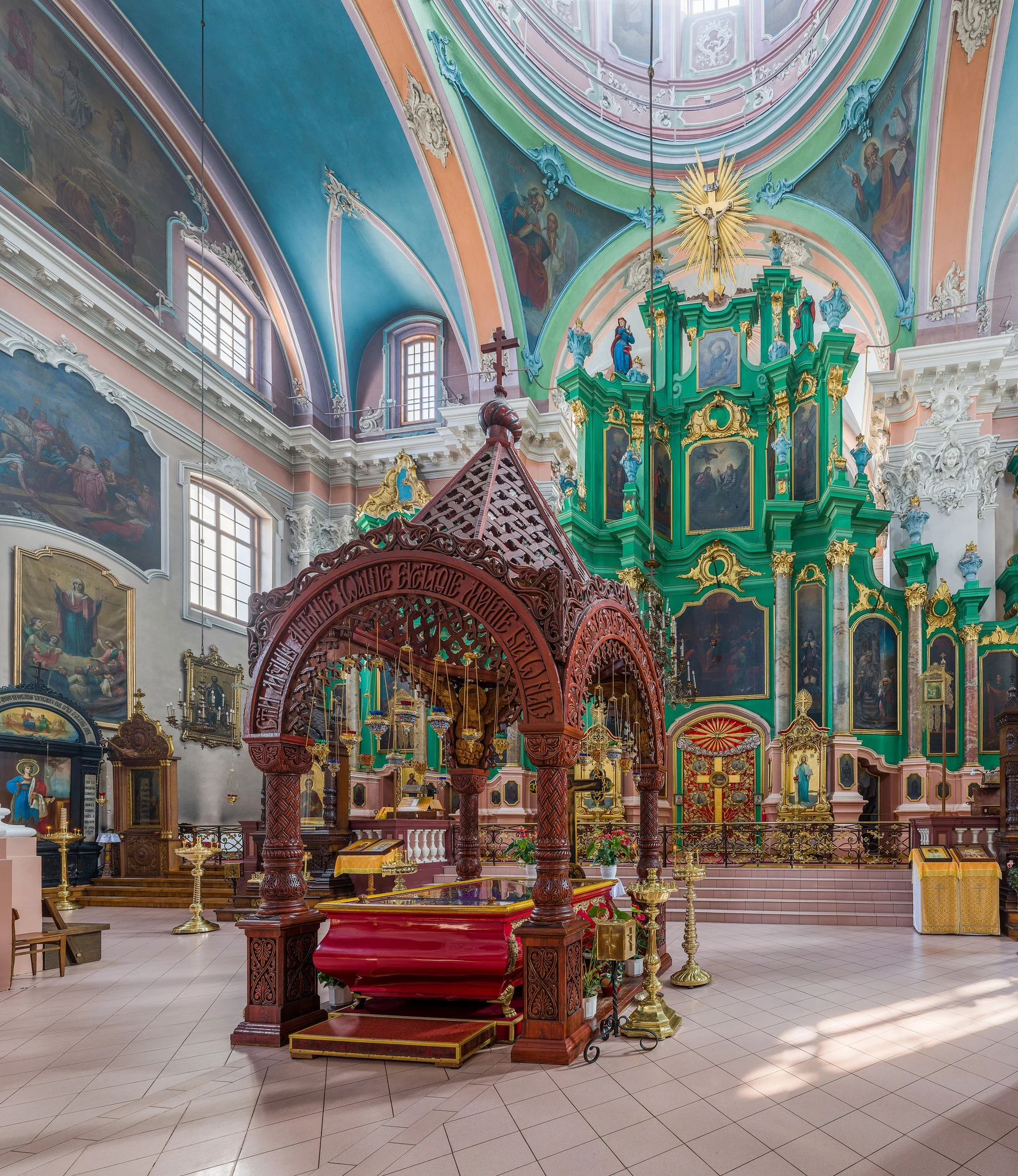
Look out, too, for the green-and-white Saint Parasceve (Pyatnitskaya) Church, where, tradition holds, Peter the Great stood as godfather at the baptism of an ancestor of the poet Pushkin; the Church of St Nicholas, a small Gothic survivor that claims to be the oldest in the city; and the Uniate (Greek Catholic) Holy Trinity Church behind the ornate Basilian Gate. Each tells a slice of the city's tangled religious history.
This layering of faiths is the real story of Vilnius's churches. Within a fifteen-minute walk you can pass from a Latin-rite Baroque basilica to a Byzantine-domed Orthodox cathedral to a Gothic brick chapel — a reminder that this was, for centuries, one of the most religiously plural cities in Europe.
- Orthodox Cathedral of the Theotokos — Byzantine domes and an Eastern-rite interior.
- Orthodox Church of the Holy Spirit — working monastery, relics of three martyrs.
- Saint Parasceve Church — green-and-white, with a Pushkin and Peter the Great legend.
- Holy Trinity (Uniate) Church and the Basilian Gate on the way to the Gates of Dawn.
A church-hopping route and the practical details
If you have one focused morning, here is the route locals would point you to. Start at Cathedral Square and the Cathedral, then walk up Pilies Street toward St John's Church inside the University ensemble, with its dizzying Baroque facade and climbable bell tower for a view over the rooftops. Cut across to St Anne's and the Bernardine complex, the Gothic showpiece, then continue up Aušros Vartų Street — passing the Orthodox Church of the Holy Spirit and St Theresa's — to finish at the Gates of Dawn chapel. That single line takes in five or six of the very best churches with almost no backtracking, in roughly two to three hours at a gentle pace with photo stops.
For the Baroque grand finale, set aside a separate trip to Sts Peter and Paul in Antakalnis, which is too far out to fold neatly into the central loop but is worth the short bus ride or riverside walk. If you only have time for one 'wow' interior beyond the Cathedral, make it this one.
A few practical notes pull it all together. Almost every church listed here is free to enter, with a donation box near the door; only a handful charge for towers, crypts or special exhibitions. Hours are tied to the liturgical calendar rather than tourist convenience, opening earliest in summer and often closing over the midday Mass, so the official Go Vilnius listings or each parish's own page are the safest source for the day you're visiting. Sundays and feast days bring beautiful music but more crowded, service-heavy buildings — wonderful to witness, less ideal for quiet sightseeing. And whatever you do, leave time simply to stand in a doorway and look up: the ceilings here are the whole point.
- Core morning loop: Cathedral → St John's → St Anne's & Bernardine → up Aušros Vartų → Gates of Dawn.
- Set aside a separate short trip for Sts Peter and Paul in Antakalnis.
- Most churches are free; some charge for towers, crypts or exhibitions.
- Confirm hours via Go Vilnius or the parish; expect earlier summer openings and midday closures for Mass.
Related guides
Vilnius Cathedral
Vilnius Cathedral is the white neoclassical heart of the Old Town, free to enter, home to the ornate baroque Chapel of St. Casimir, royal tombs and the 'Stebuklas' miracle tile on the square outside.
Read guide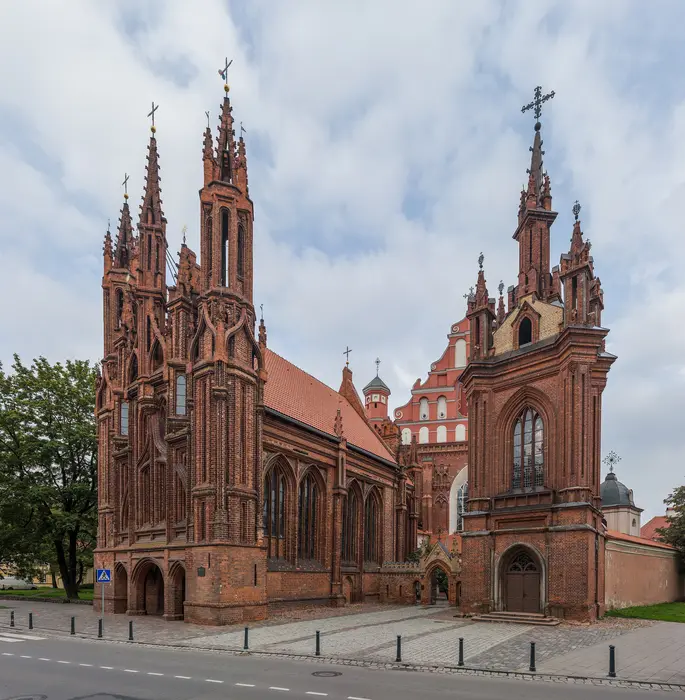
St Anne's Church, Vilnius
A guide to St Anne's Church — Vilnius's red-brick Gothic icon — its Flamboyant brickwork, the Napoleon legend, the neighbouring Bernardine ensemble and gardens, the best photo angles and how to combine it with Užupis.
Read guide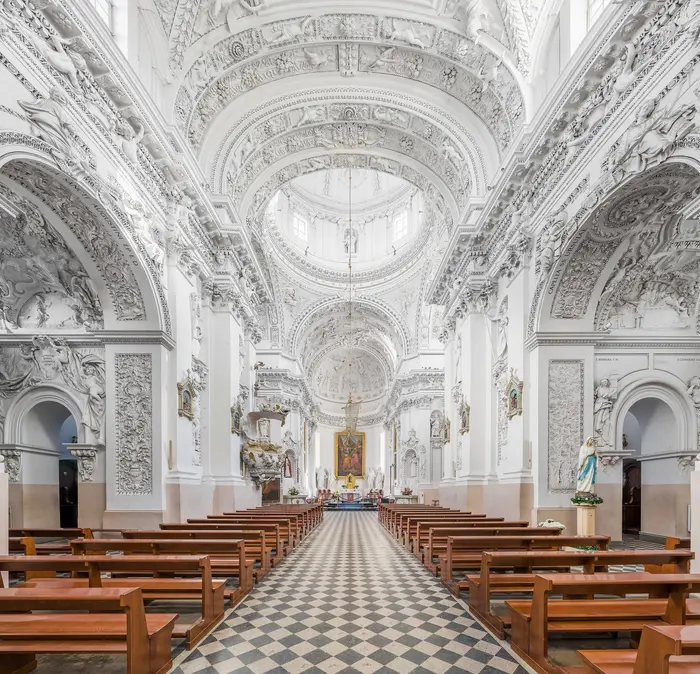
Church of Sts Peter and Paul
A Baroque masterpiece in Antakalnis whose plain exterior hides an all-white interior covered in more than 2,000 intricate stucco sculptures. Free to enter.
Read guide