
Užupis Constitution guide
Find and read the wall of constitutional plaques, with context, photos and respectful visiting notes.
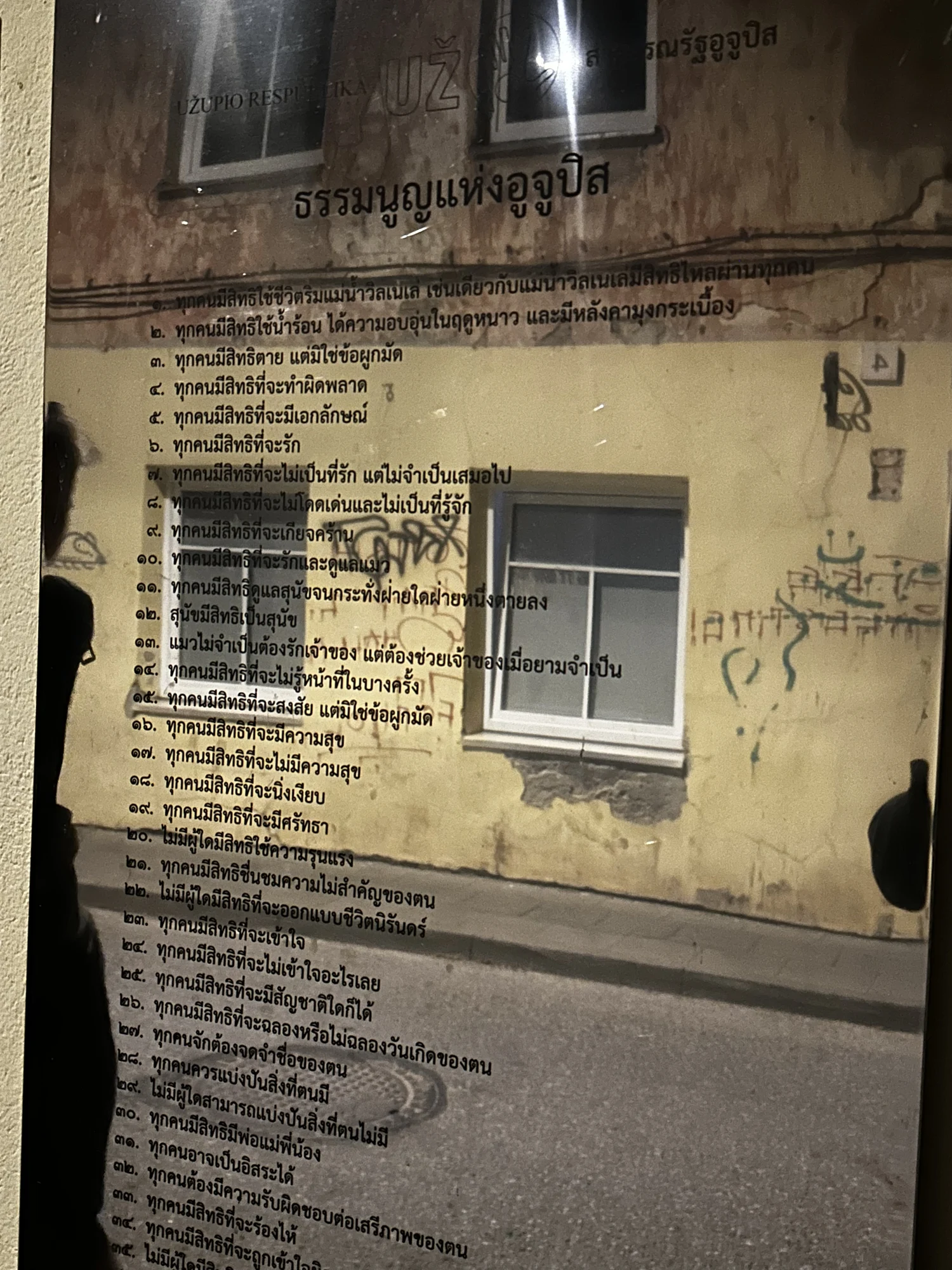
- ✓The Constitution of Užupis is engraved on a wall of mirror-finish metal plaques on Paupio Street — one of Vilnius's most quoted, most photographed sights.
- ✓It has 41 short articles, by turns poetic, absurd and oddly moving: 'Everyone has the right to be happy', 'A dog has the right to be a dog'.
- ✓Written in 1997 by Romas Lileikis and Tomas Čepaitis, it has since been translated into dozens of languages, each on its own plaque.
- ✓Free to read at any hour, a two-minute walk from the Angel of Užupis.
- ✓Bring a wide lens for the full wall and a close-up eye for your favourite articles.
Where to find it
The constitution lives on Paupio Street (Paupio gatvė), a short, easy walk from the Angel of Užupis at the heart of the republic. Look for a long stretch of wall lined with rectangular metal plates that catch the light like mirrors — you can't really miss it once you're on the street, and there's usually a small knot of visitors reading and photographing. From the angel, head toward the river and along Paupio; it's two or three minutes on foot.
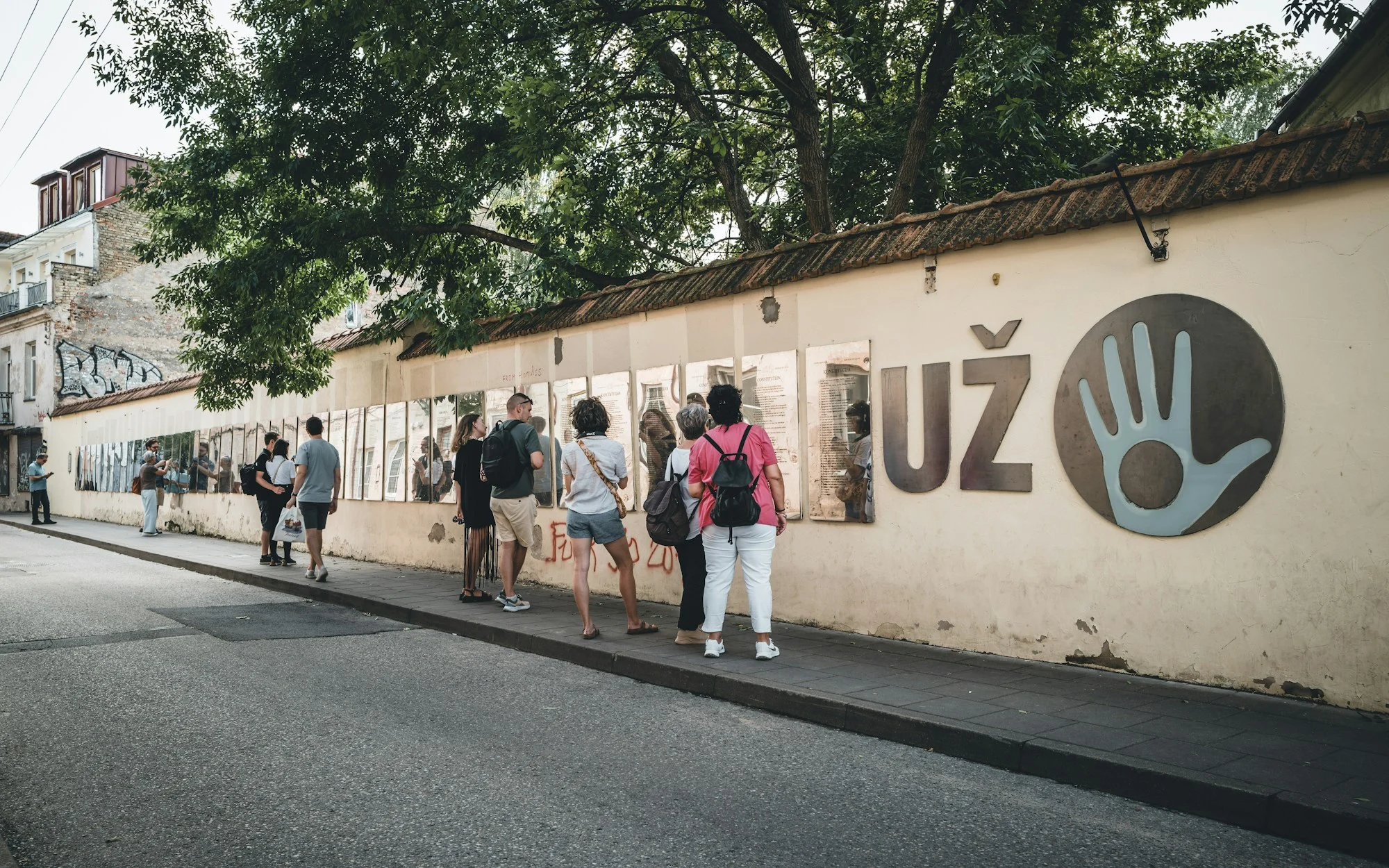
There's no gate, no ticket and no opening hours: the wall is outdoors and readable around the clock. That makes it an easy add-on to any Užupis wander, and a good early-morning stop if you want it to yourself before the day-trippers arrive. The plaques are mounted at comfortable reading height, and the polished surfaces mean you'll often see yourself reflected among the articles — which feels entirely in keeping with the republic's playful spirit.
Pair it with the angel, the river bridges and a café stop, and you have the core of a perfect Užupis hour.
If you're navigating by map, search for 'Užupio Konstitucija' or simply Paupio gatvė; the wall sits on the river side of the street. There's no admission booth, no queue and no fixed time to arrive, which makes it one of the most relaxed 'sights' in the whole city — turn up, read, photograph and move on at your own pace.
What it says, and where it came from
The Constitution of Užupis was drafted in 1997 — the same year the republic declared its tongue-in-cheek independence — by the poet and film-maker Romas Lileikis, the republic's life-long president, together with Tomas Čepaitis, its 'foreign minister'. The story goes that the pair wrote all 41 articles in a single afternoon, and the text reads like it: spontaneous, contradictory by design, and full of deadpan wit. It is the closest thing the republic has to a founding document, and easily its most famous export.
The articles are short, often a single line, and they swing between registers without warning. Some are tender — 'Everyone has the right to love', 'Everyone has the right to take care of the dog until one of them dies'. Some are absurd — 'A dog has the right to be a dog', 'A cat is not obliged to love its owner, but must help in time of need'. Some are quietly philosophical — 'Everyone has the right to be happy', immediately followed by 'Everyone has the right to be unhappy'. And a few land with real weight: 'Everyone has the right to die, but this is not an obligation', 'Do not defeat', 'Do not fight back', 'Do not surrender'.
Taken together they sketch a worldview that is tolerant, gently anarchic and humane — a manifesto for living lightly that has charmed visitors for more than 25 years. Over time the constitution has been translated into dozens of languages, each version mounted on its own plaque, so the wall has grown into a multilingual mosaic where travellers hunt for their mother tongue.
The translation project has become a small tradition in its own right. The first plaques carried the Lithuanian and English texts; French followed, then in the early 2000s came Russian, Polish, Belarusian and Yiddish — a deliberate nod to the languages once spoken in this multi-ethnic quarter and in pre-war Vilnius as a whole. From around 2009 new language plaques have been unveiled most years, often with a small ceremony, so the wall keeps growing. For many visitors the moment of finding their own language among the mirrors is the highlight — proof that the republic's gentle, borderless philosophy was meant for everyone.
- 41 articles, written in 1997 by Romas Lileikis and Tomas Čepaitis.
- Tone ranges from poetic to absurd to genuinely moving.
- Translated into dozens of languages, each on its own mirrored plaque.
- Famous lines include 'Everyone has the right to be happy' and 'A dog has the right to be a dog'.
A creative day that includes the constitution wall.
Vilnius photo spotsMore of the city's most photogenic corners.
Map pins
Map data © OpenStreetMap contributors · Tiles © OpenFreeMap
Photos and respectful visiting
For photos, the mirror-finish plaques are both the gift and the challenge. A wide shot down the wall captures the multilingual sweep and the way the panels reflect the street and sky; a closer frame lets you isolate a single article — your favourite line, or the plaque in your own language — for a shareable detail. Overcast light is kindest, since direct sun bounces hard off the polished metal and puts your own silhouette in the shot (though some visitors lean into that and make the reflection part of the picture). Early morning gives you the emptiest wall and the softest light.
A few courtesies keep the spot pleasant for everyone. It sits on a residential street in a living neighbourhood, so keep noise down, don't block the pavement for long photo sessions, and don't touch or lean on the plaques — they mark the better for being clean. There's no need to tip or pay anything; the wall is a free public artwork. And while it's tempting to treat Užupis purely as an Instagram backdrop, the constitution rewards a slower read: linger over a dozen articles and you'll leave with more than a photo.
When you're done, the angel, the river weir and the cafés are all a short stroll away — the constitution is best enjoyed as one beat in a longer, unhurried Užupis amble rather than a single tick on a list. Many visitors find it works best as a bookend to an Užupis visit: read a handful of articles on the way in to set the tone, then return after a coffee to find the ones you missed. However you approach it, give the wall more than a passing glance — its mix of wit and warmth is the clearest distillation of what the whole republic is trying to say.
- Wide angle for the whole wall; close-ups for individual articles.
- Overcast or early light avoids harsh reflections off the polished plaques.
- It's on a residential street — keep noise low and don't block the pavement.
- Free, outdoors, readable any time; combine with the angel and river.
Related guides
Užupis guide
Explore the self-declared republic: constitution, the Angel, river bridges, galleries, cafés and April 1 spirit.
Read guide
Angel of Užupis
The bronze angel that crowns the central square of Užupis — the symbol of Vilnius's self-declared bohemian 'republic' and one of the city's most-loved photo spots.
Read guide
The Best Photo Spots in Vilnius
Where to take the best photos in Vilnius — hilltop panoramas, Old Town lanes, Baroque churches, Užupis art, street art, Christmas lights and the golden-hour timing that makes them sing.
Read guide